Skip to header Skip to main navigation Skip to main content Skip to footer
Home
Post Falls Idaho
Where Nature Welcomes You Home

Main navigation

  • Home
  • Dining
  • Lodging
  • Shopping
  • Things to Do
  • Outdoors
  • History
  • Business Directory
  • Webcams
  • 7-Day Weather Forecast (opens in new tab)

Idaho Small Towns

Post Falls Business Spotlight: ATC Manufacturing Expands as I-90 Work Ramps Up

Cartoon illustration for the ATC Manufacturing business spotlight article

Good morning, Post Falls. We're waking up to another beautiful October day in the Rathdrum Prairie — sunny skies and a high near 76 degrees, with light winds and no weather alerts in effect. Thursday brings more of the same warmth with partly cloudy skies, so it's a fine midweek stretch for getting outside. Keep in mind the weekend cools down with rain chances Friday and Saturday, then clears back up Sunday.
  • Read more about Post Falls Business Spotlight: ATC Manufacturing Expands as I-90 Work Ramps Up

Post Falls Idaho

Post Falls Idaho
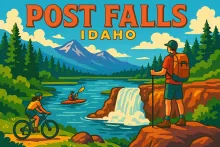
🌲 Post Falls, Idaho 🌲 📍 Where Rivers Run & Community Grows 🏞️ Nestled along the Spokane River, Post Falls blends small‑town warmth with big‑sky adventure. 🌊 Known for its scenic waterfalls, riverfront parks, and endless outdoor access. 🚴‍♂️ Miles of trails, kayaking, fishing, and wildlife right outside your door. 🏔️ Gateway to North Idaho beauty—minutes from lakes, mountains, and forests. 🏡 A fast‑growing community that still feels neighborly and grounded. 🎉 Local events, farmers markets, and family‑friendly fun year‑round. 🌅 Sunsets over the river, stars at night, and space to breathe. 💙 Post Falls — Naturally connected. Proudly local.
  • Read more about Post Falls Idaho

Five Trustees and a One-Dollar Salary: Post Falls Becomes a Town in 1891

For its first twenty years, Post Falls was mostly one man's mill town. German immigrant Frederick Post arrived at the Little Falls of the Spokane River in 1871, completed his water-powered sawmill in 1880, and put in waterworks about five years later. Settlement gathered slowly around the mill, and by the spring of 1891 the growing village had enough people, businesses, and problems of its own to need a government of its own.

  • Read more about Five Trustees and a One-Dollar Salary: Post Falls Becomes a Town in 1891

Passed by Two Votes: How Post Falls Finally Built Its New High School in 2000

Did you know the future of Post Falls High School once came down to just two votes? The school itself dates to 1912, and for most of the twentieth century it served a small mill and farming town. By the 1990s, however, Post Falls was growing fast, and its aging high school was straining to keep up with the families arriving on the Rathdrum Prairie. A new campus was not a luxury in the eyes of many parents and teachers. It was the building the town needed if its only traditional high school was going to keep pace.

  • Read more about Passed by Two Votes: How Post Falls Finally Built Its New High School in 2000

Two Churches, One Corner: How Horses Moved Downtown Post Falls Together in 1921

Stand at Fourth Avenue and William Street in downtown Post Falls today and you will see a white frame church with a tall steeple, now home to the Jacklin Arts and Cultural Center at 405 North William Street. It looks as if it has always stood on that corner. It has not. The building arrived there in pieces of a sort — two whole churches, built in two different parts of town, hauled together by horses and joined into one.

  • Read more about Two Churches, One Corner: How Horses Moved Downtown Post Falls Together in 1921

The Night the Mill Burned: How the 1902 Fire Halved Post Falls in Two Months

The Idaho Lumber and Manufacturing Company sawmill above the falls on the Spokane River in Post Falls, in a black and white photograph from about 1900.

Did you know that a single winter fire once cut the population of Post Falls by nearly half in just two months? On December 30, 1902, fire destroyed the mill plant of the Idaho Lumber and Manufacturing Company, the business that stood at the very center of this young town. The Illustrated History of North Idaho, published the following year, called Frederick Post's mill "the life of the town," and the weeks after the fire showed just how true those words were.

  • Read more about The Night the Mill Burned: How the 1902 Fire Halved Post Falls in Two Months

Sixty-Five Rooms in a Town of Six Hundred: The Hotel Mount Vernon Boom

Did you know that one of the largest hotels in Idaho once stood in a mill town of only about six hundred people? The Hotel Mount Vernon was completed in Post Falls in 1890. It rose three stories high, it contained sixty-five rooms, and it was said at the time to be one of the largest hotels in the state. A surviving photograph shows a Grand Army of the Republic convention group posed proudly in front of the building, a sign that the hotel was not only a place to sleep, but also a gathering place for the young town.

  • Read more about Sixty-Five Rooms in a Town of Six Hundred: The Hotel Mount Vernon Boom

Sixty Years to the Day: Frederick Post's Final Anniversary in Post Falls

Black-and-white portrait photograph of Frederick Post, founder of Post Falls, taken around 1900.

Did you know the founder of Post Falls died on his sixtieth wedding anniversary? Frederick Post was married to Margaret Hilt on August 7, 1848, and he passed away on August 7, 1908, exactly sixty years later. By then he had spent thirty-eight years in the Northwest, long enough to watch a rough mill settlement at the falls on the Spokane River grow into the incorporated town that still carries his name.

  • Read more about Sixty Years to the Day: Frederick Post's Final Anniversary in Post Falls

One Brick Building, a Century of Downtown: The Many Lives of the Chapin Building

The brick Chapin Building at Fourth Avenue and Spokane Street in downtown Post Falls, now home to the Post Falls Museum

Did you know one small brick building on a downtown corner has been, in turn, a drugstore, a grocery, a teen dance hall, a laundromat, a police station and a museum? That is the Chapin Building at 101 East Fourth Avenue, at the corner of Fourth Avenue and Spokane Street on the Post Falls City Hall campus. Few places tell the story of downtown Post Falls through the decades as neatly as this one building does, because as the town changed around it, the building simply changed jobs — and kept serving the same neighbors.

  • Read more about One Brick Building, a Century of Downtown: The Many Lives of the Chapin Building

From 1,069 to 38,485: The Boom That Remade Post Falls

Cartoon illustration of Post Falls growing from a few early riverside cabins into a neighborhood town with a park, prairie, river, and mountains.

Did you know that within living memory, Post Falls was a town of barely a thousand people? The 1950 census counted just 1,069 residents here. The count rose to 1,983 in 1960 and to 2,371 in 1970, but this was still a small mill town on the Spokane River, the kind of place where the falls, the timber work, and a compact downtown shaped daily life. For decades, growth had come in fits and starts, tied to mills, rails, and the river.

  • Read more about From 1,069 to 38,485: The Boom That Remade Post Falls

Pagination

  • Page 1
  • Next page ››
Subscribe to Idaho Small Towns

Copyright © 2026 Rocky Mountain Madman LLC - All rights reserved

Developed and Designed by Rocky Mountain Madman LLC